8 DAYS Luxury Adventure Safari
Trip Code: EUGA07
| Trip Focus | Birds (plus Gorillas, Chimps, Wild Cats, and Herbivores) |
|---|---|
No. of Birds Expected
|
450 – 550 Species |
Minimum No. of Participants
|
1 Pax |
Maximum No. of Participants
|
14 Pax (With 2 Field Guides) |
Mode of Transport
|
4WD Land-Cruiser Vehicles or a Coaster |
No. of Days
|
12 |
Trip Month and Dates
|
Open |
Possibility of Extension
|
Yes |
Detailed Trip Itinerary
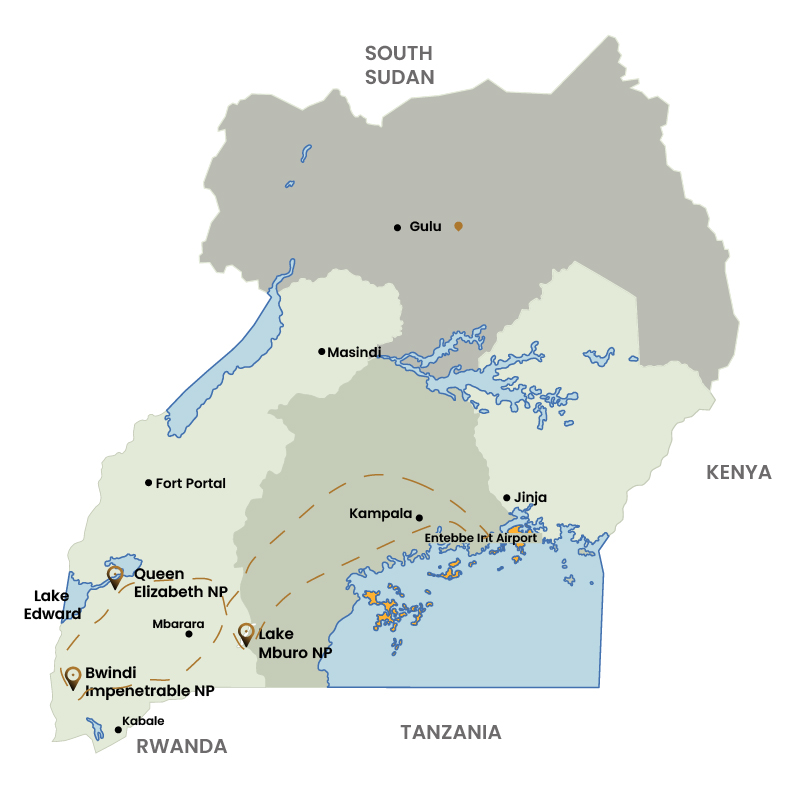
DAY 1: Arrival Entebbe Int’L Airport & Transfer to Bwindi Impenetrable National Park.
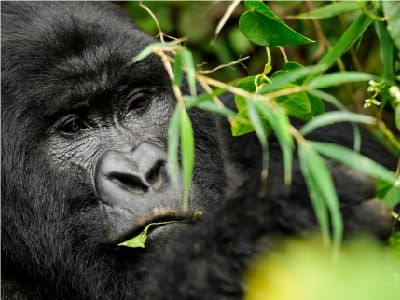
Arrival Entebbe Int’L Airport & Transfer to Bwindi Impenetrable National Park. Our drive will take us about 8 to 9 hours drive crossing the equator with stop-overs for resting and lunch breaks. Bwindi is the world’s known as a premier gorilla safari destination. With an estimated age of nearly 25,000 years old, this is one of East Africa’s oldest forests and a UNESCO World Heritage site. As a result of its elevation, which ranges from 1,160 to 2,607 metres above sea level, it is also referred to as a “true forest” and is special. Located in Southwestern Uganda, with more than 500 individuals identified, Bwindi is home to half of the last surviving mountain gorillas including those that have undergone habituation and are available for tracking. The rest are in the Virunga area, which is between Uganda, Rwanda, and the Democratic Republic of Congo. Bwindi also has the second-largest number of documented mammals in Uganda. In addition to mountain gorillas and Chimps, there are 10 other primate species, including, blue monkeys, guereza colobus monkeys, L’Hoest monkeys, and olive baboons. Several endemic species can only be found in the Bwindi Impenetrable Forest, which is located in the Albertine Rift Valley. With over 350 species documented, the birdlife is very remarkable. Of these birds, 23 are endemic, and 14 have never been seen outside of Uganda. The most desirable birds, such as the African green broadbill, the brown-necked parrot, Frazer’s eagle owl, the white-bellied robin chat, and many more, are among them. Upon arrival at Haven Lodge Buhoma, settle in and take in the views and sounds of the forest for the remainder of the day.Bwindi Impenetrable National Park lies in the rugged Kigezi highlands of South Western Uganda, protecting a continuum of forest that ranges from montane to low land areas. It is this altitudinal variation, combined with its location within the Albertine Rift that results in Bwindi impenetrable being the richest forest in East Africa in terms of its trees, butterflies and birds. Bwindi is a home over half of the remaining Mountain Gorillas populations in the World.
Bwindi is a bird watchers’ haven; it holds 400 species of birds. The forest has 10 of the 26 globally threatened species in Uganda, five of which are vulnerable. Bwindi has recorded 24 of the locally Albertine Rift endemic species in the country and some, such as African Green Broadbill, Chapin’s Flycatcher and Shelley’s Crimson-wing , Purple Breasted Sunbird and others.
Bwindi national park has 76 of 144 Guinea – Congo Forest biome species that occur in Uganda, recorded especially in the North sector. The site also qualifies for Afro tropical highland biome species with 68 of 86, and for the Lake Victoria biome with 4 of 12 species. The park is blessed with 90% of all albertine rift endemics, difficult or impossible to see in any other part of East Africa and seven IUCN red data listed species. An experienced birder watcher can identify over 150 species in a day.
Day 2: Gorilla Tracking Bwindi-Buhoma.
Uganda is renowned for its exceptional gorilla trekking experiences. Bwindi Impenetrable National Park and Mgahinga Gorilla National Park offer a haven for gorilla enthusiasts. Ensi Safaris ensures your gorilla tracking adventure is safe, informative, and memorable. Our guides and rangers are knowledgeable and committed to wildlife conservation, making your encounter with these gentle giants even more special. You should never miss the opportunity to go on a Gorilla tracking expedition since it really is a “once in a lifetime” event. Although every gorilla experience is unique and has its own benefits, you are sure to love the up-close view of adults eating, grooming, and relaxing as the young playfully romp and swing from vines.Today, we’ll have an early breakfast before we head out to the park offices for briefing by the rangers to the jungle for a gorilla tracking experience. By the 1990s, there had only been reports of less than 250 individual gorillas, and the species was in danger of going extinct. Since they are dependent on these high-altitude rain-forests to survive, habitat degradation represents the biggest concern. But as a result of increased public awareness and conservation initiatives by governmental and non-governmental groups, the population has been slowly increasing, and births are now often reported. The park now has 24 habituated gorilla groups (December 2022) therefore 190 gorilla permits are available per day. Trekking the jungle on foot due to trudging through the damp Bwindi impenetrable forest floors, searching for these gentle giants may be a little exhausting, but the joy of seeing them in person makes it worthwhile. Looking into a gorilla’s eyes, it is obvious that they and humans are related since we share nearly 96% of our DNA. Our own actions and demeanour are a reflection of theirs. Additionally, it is a wonderful experience that you will remember forever.
The trekking experience is allocated according to the gorilla families or groups and each group of 8 visitors is assigned a particular family. It is important to know your level of fitness, as the trek can take up to four hours from the starting point. A day long trek may be required for some groups as well, depending on where the family is located. Due to the fact that gorilla tracking in Bwindi might last anywhere from a few hours to all day, a packed lunch will be provided. The practice of responsible tourism has been an essential component of gorilla conservation, and the financial contributions that you make during a Uganda gorilla safari go to the community in which the gorillas are found contribute to their protection by ensuring the continued economic well-being of the people who live in close proximity to the gorillas. After supper, spend the night at Buhoma Haven lodge.
Day 3: Bwindi – Queen Elizabeth NP via Ishasha sector (Transfer)
With our packed lunch we will go to Queen Elizabeth National Park after breakfast. The 1,978 km2 Kazinga National Park, which was founded in 1920, is Uganda’s most well-known and easily accessible national park. With two sizable lakes, Lake George and Lake Edward, eleven crater lakes, the Kazinga River, two forests, the Kyambura and Maramagambo forests, and wide savanna grasslands, the park has an unmatched variety. The number of animals documented is 95, the most of any national park in Uganda. With 610 species reported in total, the park has the largest number of bird species of any national park in Africa, and maybe the whole globe. We will drive through Ishasha sector in search of tree-climbing lions and an Antelope called Topi. Later we will proceed to the north for check-in at Engiri game Lodge.
Day 4: Chimpanzee tracking at the Gorge and the afternoon boat trip
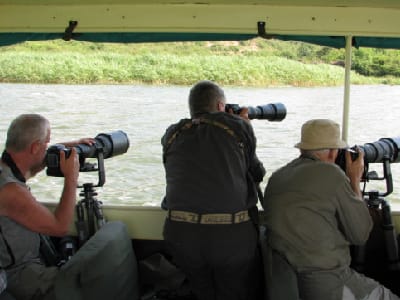
After an early breakfast, we will go for a chimpanzee tracking experience in Kyambura Gorge. The Kyambura river gradually eroded its banks to create the 16-kilometre-long canyon. During the dry season, when animals descend into the valleys to graze on the forest foliage and drink from the gorge, the riparian forest serves as a buffer zone and an oasis in the savanna. The terrain is a little challenging because of the incline where we will be chimp trekking, but the experience of spending time with these animals is still quite fulfilling. This is a good place to spot these clever animals as they go about their regular eating, playing, grooming, and exhibiting duties. While keeping an eye out for other primates and birds, we will spend an hour with them. Watch out for baboons, red-tailed monkeys, and black-and-white colobus monkeys. Kyambura is a great spot to see black bee-eaters and blue-bellied kingfishers. Hot lunch will be served at the gorge.We’ll take a boat tour of the Kazinga waterway in the afternoon. One of the park’s biggest draws is the channel, which attracts a large number of birds and other thirsty creatures that come to drink under the scorching Savannah sun. The 32-kilometre-long Kazinga channel connects Lake Edward and Lake George, the park’s two largest lakes. The waterway offers fantastic opportunities to see herds of elephants, buffalo, and antelope. In addition to being one of the locations where you may view large, powerful crocodiles lazing in the sun, this area has the largest number of hippos in all of Uganda. The variety of birds is outstanding. A number of plovers, kingfishers, and gulls are to be seen, along with species like the Yellow-billed Stork, Pink-backed Pelican, Water Thick-Knee, Black-headed Gonolek, African Skimmers, Papyrus Gonolek, and many more. After supper, head back to the lodge to spend the night.
Day 5: Queen Elizabeth – Morning and afternoon - Game drive
After morning breakfast we go for the game drive in the Kasenyi area and the queens’ mile. The drive will reward you with animals like elephants, lions, buffaloes, Uganda Kob, Warthogs, bushbucks, bushpigs, white striped jackal, bush pigs, and others including scenic views of salt lakes acacia woodlands and fresh water bodies. Lunch will be served at the game lodge.
Day 6: Queen Elizabeth NP-Lake Mburo NP
This day after breakfast we will drive to Lake Mburo NP arriving early mid-day for check-in and early lunch at the lodge we go for a launch cruise on the lake in search of waterbirds like the uncommon and elusive African Finfoot and maybe even a White-backed Night-Heron, which is the neotropical Sungrebe’s African relative. Other birds that may be seen on the lakeshore including African darter, African spoonbill, African fish eagle and more.
Day 7: Lake Mburo NP to Botanical Beach Hotel -Entebbe
This day after breakfast we will go for the morning game drive in the park. The wide savanna and marsh habitats of Lake Mburo National Park will be explored in the morning. These habitats mirror the classic savanna settings of Kenya’s Masai Mara, but with a lot more prickly acacia thicket. In Uganda, quite a few species are very specialised and are found nowhere else. The red-faced barbet, which has a limited range in Rwanda, Burundi, Uganda, and Tanzania to the west of Lake Victoria, will be our main avian target. Other species to look for are Tabora Cisticola, Emerald-spotted Wood-Dove, Green-capped Eremomela, Golden-tailed Woodpecker, African scops owl, African stonechat, African grey hornbill, African wood owl, and Spot-flanked Barbet.In such a little park, there are surprisingly many raptors. African Marsh Harrier, Black-chested, Brown, and Banded Snake Eagles, Bateleur, African Harrier Hawk, Shikra, Gabar, and Dark Chanting Goshawks, Lizard and Augur Buzzards, African Fish eagle, Tawny eagle, Steppe eagle, African Hawk eagle, Long-crested eagle, Martial Eagle, and Grey Kestrel are among the 35 species recorded. The well-known safari animals, will include warthogs, elands, common zebras, and impalas, may be seen at Lake Mburo, which is also a great park for mammals
Day 8: Botanical Hotel – Mabamba – Entebbe Airport.
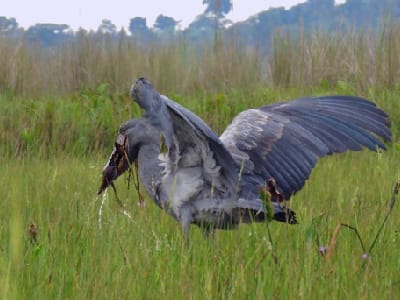
Enroute to Entebbe International Park, we make a detour at Mabamba wetland, a RAMSAR site and notable birding location. It is home to over 500 bird species and is an important habitat for the renowned Shoebill Stork (Balaeniceps rex). Several endangered species, such as the Blue Swallow (Hirundo atrocaerulea), Papyrus Yellow Warbler (Chloropeta gracilirostris), and White-winged Warbler, find sanctuary in the swamp (Bradypterus carpalis).The Shoebill, Uganda’s most recognisable bird, is the focus of our first significant task of the journey. In order to enter the shallow canals of a swamp, we drive to its edge and board tiny boats. Hopefully, we will see this beast with a primitive appearance standing in the swamp or swooping above.
Contrary to popular belief, the shoebill is not restricted to papyrus groves and may instead be found in the low vegetation that lies between them. The Lesser Jacana and the Yellow-billed Duck Several sightings are anticipated in these open places.
We will also bird the dense papyrus stands, keeping an eye out for Greater Swamp-Warblers, Papyrus gonolek, Blue-chested Bee-eaters, Malachite kingfisher and Swamp Flycatchers as they traverse the narrow canals between the papyrus stands. The remainder of the day will be spent travelling to Entebbe International Airport for your homebound flight.
End of Nature Tour
Transport
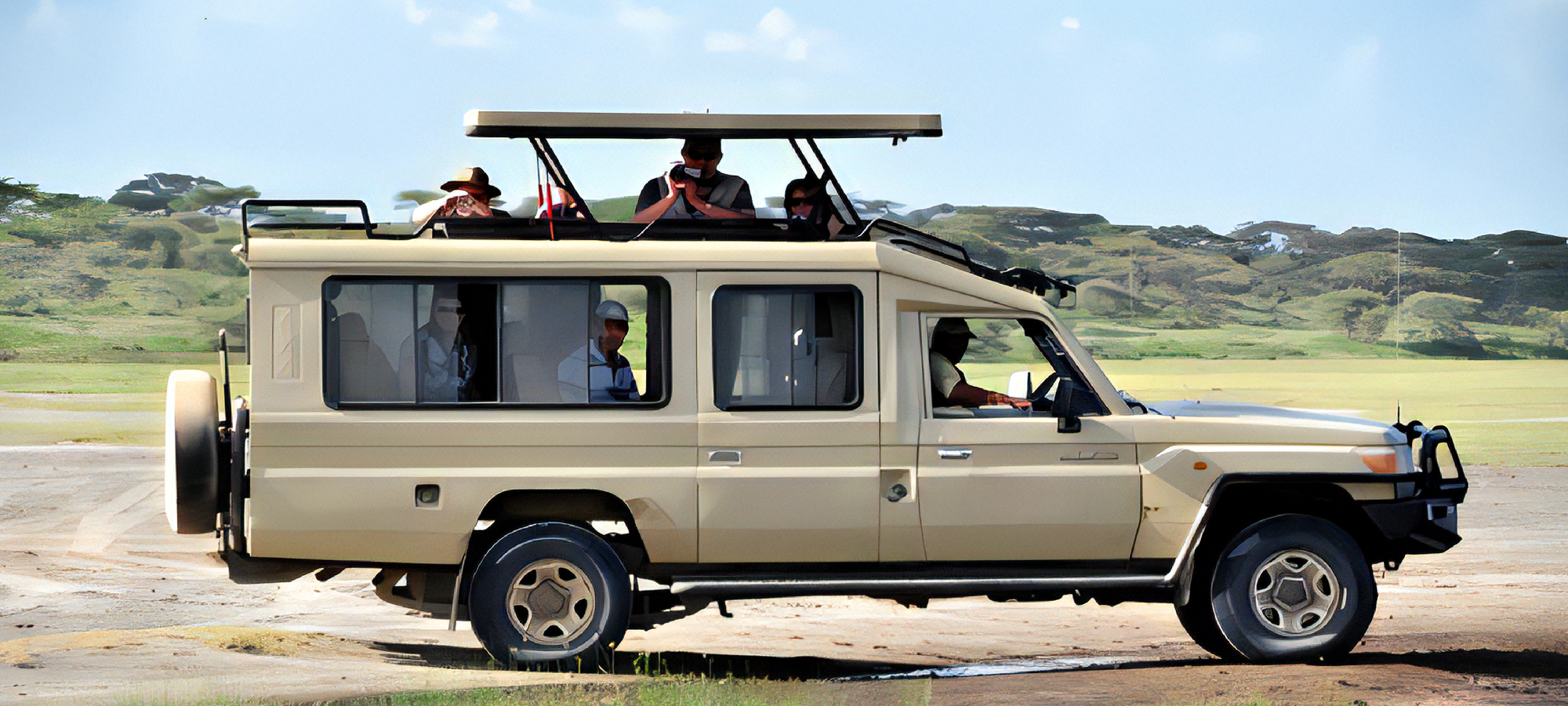
We will use Toyota Land cruisers for this tour. Each vehicle has sufficient window seats for the whole group to have one, although we would ask that you rotate around the vehicle to give everyone the opportunity to have a seat towards the front of the vehicle. A good amount of our time will be spent away from the vehicles on bird walks.There is a good amount of luggage space in the vehicles, however, it is preferable if you can bring soft-sided luggage as this is easier to pack in, and keep your packing to a sensible, practical minimum.
At Mabamba Swamp and Queen Elizabeth National Park, we will also use boats or canoes to view birds from the water. Life jackets are available and it is recommended that these are worn throughout the boat trips.
Weather
A typically equatorial climate ensures that the weather will be varied, and you are likely to encounter some rain on tour. Showers should not last too long and will not hamper the birdwatching. Days will generally be warm or hot and sunny; however, overcast conditions are frequent, particularly in the forest and mountain areas. Nights will be mild to warm, cooler at higher altitudes.
Group Size
This tour can be accompanied by an International tour leader together with a local field ornithologist, and a driver. The minimum group size is 1 pax and the maximum group size will be 14 pax. Group size determines the number of field guides leading a tour. For example, if the group size is 14 pax we 2 field guides with 2 vehicles participate in the trip. If a big group opts to travel in one vehicle, we use a mini coaster. All the two transport options are perfect for your tour.Food & accommodation included in the package
All accommodation and meals are included in the cost of this holiday trip, drinking water will be available in the tour vehicles during the day throughout the trip. Please bring a water bottle, so that you can refill it from the larger containers.We use a combination of comfortable lodges, tented camps, and guesthouses on this tour. Whilst standards are improving in Uganda, some of the accommodations can be quite simple in nature. All rooms are clean, however, with private facilities and should be perfectly adequate for the group's needs. If you experience any problem with your room, please let your local guide know and they will always endeavor to rectify the problem with the lodge. A number of lodges operate generators for electricity, which are only run during the day so keeping a torch by your bedside is useful in case you need to get up at the night.