Mist-Netting and Banding Fieldwork - Summer Field Trips
Contact Us So We Can tailor Your Summer Trip with You!
Winston Churchill once called Uganda the Pearl of Africa. Indeed, this is true as Uganda is one of the most beautiful and diverse countries in Africa. It is a country dominated by great lakes, the birth of the Nile River, vast forests and savannas, and the mist-shrouded peaks of the Ruwenzori – the famed “Mountains of the Moon”. For the wildlife enthusiast, Uganda is uniquely positioned between the faunal groups of East Africa and West Africa. It also sits on the boundary between dry Northern Africa and Sub-Saharan Africa. This geographical position produces a mixture of species from different regions and allows such a small country to have incredible biodiversity.
Students/scientists/NGOs are welcome
This trip has been designed specifically for students and scientists who are interested in bird banding in Uganda. Students will also be immersed in Ugandan culture, and learn about the importance of ecotourism in the country.
Bird banding field trips are tailor-made there-by giving us the intended length of fieldwork trip and places of interest to enable us to plan well for the team(s).
If you are interested, please inquire by emailing us at:
info@ensinature.com
Useful Information
Bird banding or ringing
Bird banding is the application of a band or ring to a wild bird that allows for its identification. Banding is used as a research tool to determine the basic life history of birds and the tracking of their movements. Researchers’ recapture of banded birds can provide information on longevity, mortality, aging, and sex characteristics. Importantly, information can also be discovered about local and regional movements, global migration, population dynamics, territoriality, and behavioral ecology.Bird banding or ringing is important for continuing research on bird nesting and migration patterns, and for educating birders about aging birds from the condition and molting stage of their feathers as indicated above.
Many hatch-year birds (those newly hatched) with new feathers are identified by the crisp edges and pointed tips. Older feathers on adult birds will look worn and the tips can be frayed or broken. Using the quality of a bird’s feathers to determine a bird’s age can be an excellent aid in identifying birds in the field.
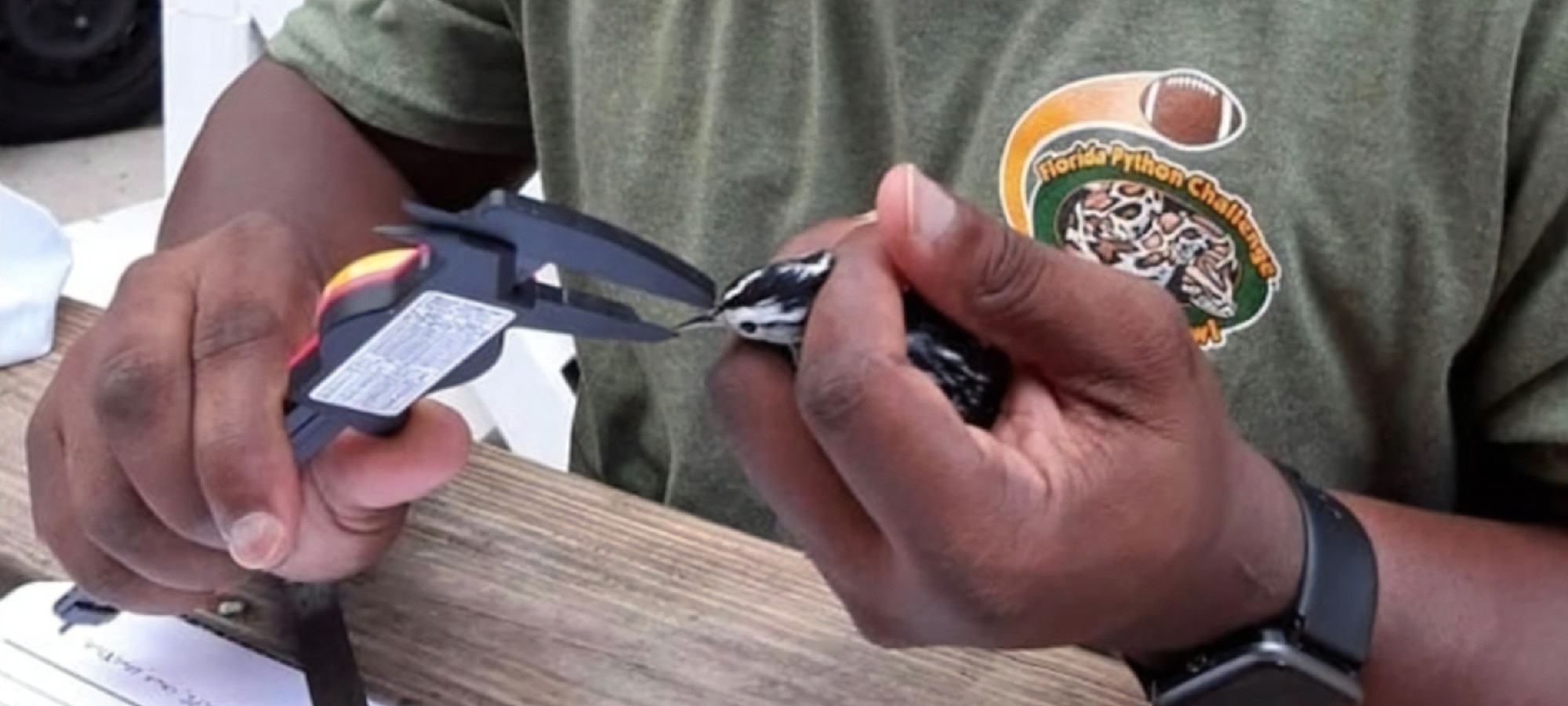
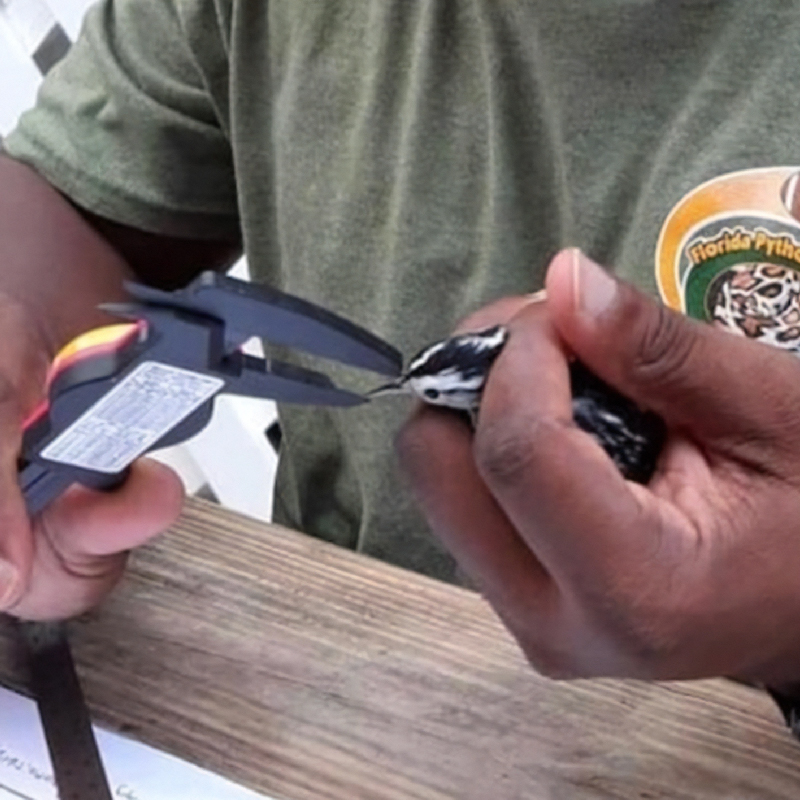
Each bird is logged noting its identification to species or subspecies, sex, age, and then weighed. Bird banders learn how to safely hold the bird around its neck between the index and middle fingers and cupped in the palm. The bird can easily be turned over for inspection of its fat reserves when the bander softly blows the feathers apart on the belly. The quality of the fat reserves is also logged. Finally, a metal band etched with serial and telephone numbers is attached to the bird’s leg, so that the station can be notified if anyone finds the bird or if it is recaptured in the future.
How do you catch birds?
We catch birds in a fine nylon mesh net called a mist net, which is strung up between two poles. The fine mesh is not immediately visible against the background vegetation, so the majority of birds fly into the net and are caught.The essential equipment required to capture birds (as per my kit!), includes:
• 15 pairs of aluminum or wooden poles (each pole in three sections), in a custom-made canvas bag.
• 20 mist nets, that measure around 10 feet high and of various lengths between 20 and 60 feet.
• Enough guy ropes (made out of Venetian blind cord) and tent pegs for the number of nets, plus a mallet, in another old backpack.
• 100-200 lightweight, white cloth bags with drawstrings, for holding birds
• Seam ripper (stitch picker), for cutting net strands should that be necessary.
The 40-foot-long mist net pictured below is stuffed into a bag measuring 15cm by 25cm. The ten-foot-high net is divided into four panels or shelves. The top shelf string is white, and the other four black shelf strings tie onto the white string in order. This method makes it so easy to set up a net very quickly, no tangles, no mess!
The essential equipment for operating a bird banding station:
• Many hundreds of bird bands, of multiple sizes, each of which is uniquely numbered.
• Color bands, of multiple colors and sizes.
• Pliers for applying bands.
• Pliers and some other bits and pieces for removing bands.
• Spring balances for measuring weight.
• Calipers and metal rules for measuring body parts.
• Hand lens (with integrated LED).
• Datasheets and writing tools.
• Manuals (e.g. bird aging and sexing guide).
Managing a banding crew
The key objective for a banding field trip is to catch as many birds as we can, given the human resources available, while paying particular regard to the target species for color banding that can be monitored.The number one variable that determines what you can do is the number of people available. In particular, the number of fully trained/qualified/licensed bird banders is key, as they are the ones that do the bird extraction and processing.
Additional people such as trainees, volunteers, students, and other visitors can help in many ways, such as scribing data and assisting on net rounds like adjusting the nets, distributing empty bird bags to extractors, carrying bagged birds, acting as a runner back to the banding station.
Managing volunteers and students on such field trips is very much like managing people in a workplace. The focus must always be on the health, safety, and well-being of the people volunteering their time.
Further, students and volunteers are monitored for fatigue, and, as expected, no one wants to be doing the same task all day. So we make sure that people are rotated for different tasks, to avoid that feeling of being stuck doing the one activity. Anyone person in any given hour might do a net round, sit and process five to ten birds, scribe for 20 minutes, and make a cup of tea!
While the priority is to catch and band as many birds as possible using qualified people, it is also important to ensure that trainees get enough birds to work on under supervision, and that includes extracting and processing. Once the humans are taken care of, the next most important thing is the well-being of the birds.
At the end of the field trip, I want students, volunteers, and others to leave satisfied, that they got what they wanted out of the trip and that they had a good time!
Some researchers working with wild animals consider there to be an acceptable loss rate of study animals, be it through predation in a net or something related. In my view, no loss is acceptable, but I do understand that losses occur occasionally. Losing less than five individuals out of a couple of thousand birds might be considered acceptable, but if one of those birds is a known individual with a couple of years of breeding history that particular loss can be hard to take. The bottom line is we mitigate risks to avoid loss.
Net set up
Setting up mist nets can be a time-consuming exercise. In an ideal situation, a crew would set up at a banding site in the early afternoon, operate those nets that evening and the following morning, then move the nets to new sites in the early afternoon. Of course, nets can stay in one spot for two mornings in a row, but we’ve found that on the second day the capture rate is lower, the birds just get used to the nets (and the people).An experienced crew of three can set up a mist net in just a few minutes. Just two people take a little longer and require a good routine. Setting up by yourself is possible, but difficult and time-consuming. A crew of four is no more efficient than a group of three. Taking down a net is much quicker and can be easily done by one person.
Capturing the birds
Ok, the nets are open, the crew is allocated tasks and the staggered breakfast consumption is underway. Time for a team to check the nets. Just how does that happen? Here is a brief rundown.• On approaching a net site, silence is key to not disrupting birds in the area.
• Blend in, by wearing clothing that matches the habitat.
• Work quickly, without rushing, so you are at that net for as little time as possible.
• Have bird bags for each bird out of the carry bag and ready to be used.
• Start extracting birds from the bottom shelf first, they may be hanging to the ground and be badly tangled with forest litter, vegetation, or even subject to ant attack.
• Extract other vulnerable birds, such as those hanging in direct sunlight.
• For each bird, assess the way it went into the net, as it’s only going to come back out that way.
• Bag the bird, pull the drawstring tight, and tie a single knot around the neck of the bag so the bird can’t muscle out through any small gap.
• Bagged birds hang in a nearby tree or shrub in the shade, or are placed in a net pocket if that doesn’t interfere with other extractions; the golden rule is a bird in a bag never goes on the ground.
• Reset the net so it is ready to catch more birds.
• Collect the bagged birds and move to the next net.
Extracting very tangled birds takes patience and dexterity. A bird might hit a net, tumble down into the pocket created by the shelf string, flip itself around that string, and into the pocket a second time. A nightmare! However, even a messy bird can come out in a few seconds with practice.
It is vitally important to operate mist nets according to the weather conditions and the load captured.
Some species like warblers don’t cope well with cold hands and can get stressed if they are captured early on before they have had a chance to forage for food. It was not unusual to see a member of the crew return from a net round with a bundle of birds in bags, with one or two birds in bags down the front of their jacket for warmth. These were treated as priority birds, being processed and released quickly.
If quite a lot of birds are caught in the first net or two, they are bagged and sent back to the station immediately before completing the net round. If in my opinion there were too many birds to process before the next net round, consideration would be given to closing nets. Birds hanging in nets for too long means they could be subject to suboptimal conditions (e.g. predation by birds of prey and wild cats)
We try as much as possible to avoid interfering with breeding activity. For example, if we caught a breeding bird two or three times, we would close and move the net.
The banding station
The banding station was at a central point on the site and is the start and endpoint of a circuit of net sites. Ideally, the banding station would have:• Shelter from sun and rain, for humans as well as birds waiting in bags or being processed. • Enough space for a couple of tables and several chairs, for the people doing the bird processing. • A rope strung between two-star pickets (metal fence posts) for birds in bags to be pegged on to. • A bucket, for dirty bird bags that should not be used again. • All necessary equipment and paperwork. • Extra space for resting/relaxing, eating, and socializing.
Note that the socializing must be far enough away from the banding table so that it doesn’t interfere with the concentration of those people processing birds!
We would typically have two or three banders working with two scribes, with plenty of other people swapping in and out so everyone gets a break.
One of our banding stations in the field, pictured below, was a modest affair, yet comfortable enough, and largely sheltered from the elements thanks to a large tarp. Comfortable chairs are essential so that a person may sit for extended periods during busy processing times.
The color banding process
The main objective of color banding a bird is to be able to identify a specific individual in the field by sight, eliminating the need to recapture it to read its metal identification band. Many behavioral ecology studies rely on the marking of individuals in the field, so researchers can observe behavior (usually, who is doing what and to whom!)The photo below shows a researcher applying an orange color band to a species. The split ring plastic band is gently pushed up the small aluminum spoon so that it opens enough to be placed over the bird’s leg. The spoon is removed and the band goes back to looking like a solid band. A few squeezes with the fingers, and that band is not going to come off. Larger species, particularly those with strong bills, require the bander to glue the bands shut so they cannot be removed. Many of the color bands are made of PVC, so a plumber’s glue (that only sticks PVC to PVC) is used to seal the bands, ensuring that the bands cannot be removed by their new owner. Avoiding the use of other types of glue means we are not sticking bands to our fingers or indeed gluing the bands to the bird’s leg.

Below, is a small tackle box full of color bands, in four sizes that fit most small to medium birds. Plenty of orange bands as that was the master color for our site. There are three application spoons to the right. The guide to aging and sexing bush birds are underneath!
Another box of larger bands, and a collection of anodized aluminum bands (a couple of species have had issues with plastic bands, so metal bands are being trialed). The large bands to the right are wrapped around rather than split ring bands, making it very difficult for the birds to get them off (and we glue those as well!).
We hope that mist-netting and banding will help gather data that leads to an improved scientific understanding of both resident and migratory birds in Uganda, and more effective conservation, and education programs.
Day 8: Whole day along birding Buhoma Main Trail.
This morning, we will bird Buhoma’s main trail. This forest merges birds of the low and highland elevations. A good day yields a significant number of Guinea-Congo forest, and Albertine Rift montane ranges specialties. We will do the first minutes birding the secondary forest to be rewarded with undergrowth dwelling Grey-winged, Red-capped, Blue-shouldered and Snowy-crowned Robin-Chats, Grey, Black-throated and Buff-throated Apalis, Grey-headed and White-breasted Negrofinch, White-bellied Robin-Chat, Cabanis’s Greenbul, Red-headed Malimbe, Dusky Tit, Red-chested, Klass’s and African Emerald, Cuckoos, Chubb’s Cisticola, Northern and Mackinnon’s Shrikes.Also, when we get to the primary forest when the light is at its best, we should find African Shrike-flycatcher, African Broadbill, Red-throated Alethe, Red-tailed Bristlebill, flocks of Red-tailed Greenbul, Neumann’s Warbler, and the nearly impossible Kivu Ground-Thrush. The mixed flocks should be great for Golden-crowned Woodpecker, Jameson’s Antpecker, Cassin’s Honeyguide, Petit’s Cuckoo-shrike, and the recently split Willard’s Sooty Boubou. More birds should add to the list by the end of the day.
DAY 9: Transfer to Queen Elizabeth National Park.
From the montane forests, we drive to the Great East African rift valley. We shall bird through the Ishasha sector which is the southern section of Queen Elizabeth National Park and have a wonderful time working on our woodland and open country birds again. On sunny days, the sky here is excellent for observing some raptors many of which may have been seen earlier. Most likely to be new should include Gabar Goshawk, White-headed, Lappet-faced Vulture, Rufous-breasted Sparrow-hawk, and Banded Snake-Eagle.This stretch usually offers Impressive views of Wing-snapping, Croaking and Stout Cisticolas, flocks of White-winged Widowbird, White-headed Barbet, Pin-tailed Whydah, Moustached Grass-Warbler, Broad-tailed Warbler, Greater-painted Snipe, Malagasy Pond-Heron, Red-shouldered Cuckoo-shrike, Scaly and Red-necked Francolins.
Normally at this time of the trip, the desire to see the big game will be high, and we will be having good chances for African Bush Elephants, Leopards, and Lions in the trees.
DAY 10: Whole day birding and game drive in Queen Elizabeth National Park
Queen Elizabeth National Park tends to start with a lovely sunrise, if we have a clear day, we should expect it. The Kasenyi side is most preferred in this section of the park; this is because it offers excellent lekking grounds for the Kob. Game viewers drive there, first thing in the morning, and birders too, love it a lot for its open grasslands and sparsely distributed thickets that provide perfect microhabitats for quite shy birds. It also offers the best chances for birds like Verreaux’s Eagle-Owl, Rufous-napped, White-tailed, Red-capped, and Flappet Lark, African, and Jackson’s Pipit. These four larks mentioned, are a significant target when starting this morning drive. We should see Temminck’s Courser, Black-crowned, Senegal and Wattled Lapwings, Kittlitz’s Plover, Yellow-throated Longclaw, White-backed Vultures, Ruppell’s Griffon, and the the others soring the sky, Black-chinned, and Black-faced Quail-finches, and also observe Kob lekking ground activity. Keeping up with the game birding tradition, we will scan openings, thickets, and Euphorbia Candelabrums for Lions. Euphorbia Candelabrum is a cactus-like plant that dominates this part of the park.After lunch, we shall do an afternoon boat ride on the Kazinga channel. This 40 km natural channel connects two major lakes in this park; Lake George and Lake Edward. Because of the significant wildlife activity at the banks of the channel, we only cover a less than 4km distance, and this takes us to lake Edward for a turning point.
This boat ride typically targets congregations of birds and big mammals when they come down to cool off during the heat of the day. We should get good looks at fishing African Spoonbill, a few African Skimmer, Gull-billed and White-winged Terns, a few shower birds depending on the season and these should include Curlew Sandpipers, Common, Marsh, and Wood Sandpipers, Common Greenshank, Ruff, Little Stint, Ruddy Turnstone, Black-tailed Godwit, Three-banded Plover, and Common Snipe. Other good birds to expect to see include four Gulls; Lesser Black-backed, Heuglin’s, Slender-billed and Grey-hooded Gull, both Great White and Pink-backed Pelicans, Great and Long-tailed Cormorants, Yellow-billed, Marabou, and Woolly-necked Storks, our first of the many Red-throated Bee-eaters and many more. If we choose to go out for a short evening drive, we will have chances for Square-tailed and Black-shouldered Nightjars.
DAY 11: Travel to Kibale Forest National Park.
We will leave Queen Elizabeth National Park keeping an eye in the bushes looking for Black-headed Batis, and Black-crowned Tchagra while we enjoy a very scenic and photogenic drive along the Mountains of the Moon. We will leave for the Bigodi Sanctuary Wetland, shortly after arriving at our accommodation. The sanctuary is a community-based initiative and one of the most successful few in the country. With our site guide from the community, we should go around and through the papyrus looking for White-spotted Flufftail, Hairy-breasted, Yellow-spotted and Yellow-billed Barbet, Black-and-White Shrike-Flycatcher, Joyful Greenbul, Blue-throated Roller, White-collared Olive back, Superb Sunbird and a Shinning Blue Kingfisher. The walk also being famous for primates, we should see Uganda’s Red Colobus which are threatened in this region for being preyed on by Common Chimpanzee. The Uganda Mangabey, Olive Baboon, Mantled Guereza, L’Hoest’s, and Blue Monkey are also very likely to show up.
DAY 12: Whole day birding; Chimpanzee Tracking (Optional)
Kibale National Park is the best travel destination for chimpanzee tracking in East Africa and can best be defined as the loveliest and most varied of all tropical rain forests in Uganda. It is christened the primate capital of the world because it hosts 13 species of primates including the chimpanzee (Man’s closest relatives- sharing over 98% DNA). It has 1450 chimpanzees, and these represent Uganda’s largest population of this endangered primate species.In this forest, we will look for the Chimps and also do an early start for the Green-breasted Pitta. This Pitta is one of Africa’s most difficult birds to find! The time we should spend in the forest looking for the Pitta, we will also look for White-throated Greenbul, Crowned Eagle, Thick-billed Honeyguide, Brown-chested, and Fire-crested Alethe, Crested Guineafowl, Western Black-headed Oriole, Blue-breasted Kingfisher, Blue-throated Roller, Yellow-browed Camaroptera, Brown-eared Woodpecker, Western Nicator, Dusky Long-tailed Cuckoo, Bronze-napped Pigeon, Yellow-mantled Weaver, Lesser Honeyguide, Red-chested Owlet, and African Wood-owl among others. On this day we may opt to visit Bigodi Swamp mixed forest. Bigodi Wetland Sanctuary, located just outside the park, is home to 138 bird species which may be seen during guided walks along the boardwalk trail and viewing platforms. These could include the White-spotted Flufftail, Yellow-spotted Barbet, Hairy-breasted Barbet, Yellow-billed Barbet, Western Nicator, Grey-winged Robin-chat, White-tailed Ant-thrush, Brown-backed Scrub-robin, Black-and-white Shrike-flycatcher, Brown-throated Wattle-eye, Superb Sunbird, Brown-crowned Tchagra, Bocage’s Bush-shrike, Black Bishop, White-breasted Negrofinch and Black-crowned Waxbill among others.
DAY 13-14: Travel Semliki Forest National Park via Bigodi wetland.
Early morning visit at Bigodi Wetland, a haven for bird watchers as you get to see a variety of birds in forested swamp habitat. Highlights here include Brown-eared Woodpecker, Abyssinian Ground Thrush, African Pitta, Black Bee-eater, Black-headed Apalis, Black-eared Ground Thrush, Blue-breasted Kingfisher, Brown-breasted Alethe, and Collared Apalis, African Crowned Eagle, White-collared Oliveback, Little Greenbul, Purple-breasted Sunbird, Western Nicator and the Yellow-rumped Tinkerbird. Or we may opt to return to Kibale forest which is adjacent to Bigodi Wetland in the quest for Green-breasted Pitta in case we missed it the previous day before heading to Semliki.In the afternoon transfer to Semliki Forest with a lunch break at Gardens Restaurant in Fort Portal Town. After lunch, proceed to Semliki Forest, where you will arrive in time for evening birding around the hot springs. Over 435 bird species have been recorded in Semliki National Park. The checklist includes 35 Guinea-Congo forest biome bird species, Spot-breasted Ibis, Hartlaub’s Duck, Congo Serpent Eagle, chestnut flanked Goshawk, and Red-thighed Sparrowhawk. Furthermore, another 12 species with extremely little distribution are spotted like the western bronze-naped pigeon, Yellow-throated Cuckoo.
DAY 15: Whole day birding in Semliki Forest.
This morning we bird Semliki Forest to collect some of the few Guinea-Congo forest biome specialities that have this forest, as the most eastern extension. Being the only connection to the Ituri forest from DR Congo makes it that spot where over thirty-five restricted-range specialties exist in East Africa. When the resident birds are breeding, it is effortless to spot Black and Southern Red Bishops, Piapiac which is a social crow, Rattling and Whistling Cisticolas, and Mosque Swallow before entering the forest. When we get to the forest, we will work for excellent views of Piping, White-crested, Black Dwarf Hornbill, the canopy-dwelling Red-billed Dwarf, and the gigantic Black Casqued Hornbills. Other good birds like Yellow-lored Bristlebill, Yellow-throated Nicator, Black-headed, and African Paradise Flycatchers, Forest Robin, African Piculet, African Dwarf Kingfisher and Hartlaub’s Duck, Xavier’s Greenbul, Red-tailed Ant-thrush, Crested Malimbe, Dusky-crested Flycatcher, Grant’s Bluebill, Orange-cheeked Waxbill, Black-bellied Seed-cracker, Grant’s and Red-headed Bluebills, Brown Illadopsis are among others that we will look for.
Day 16: Whole day in Semliki forest
(On this may we may require to camp in the middle of the forest in search of African Piculet including other difficult to find species near an oxbow lake). The first three kilometers of the Kirumia trail is actually a network of trails that crisscross through the ironwood-dominated forest. Spend the entire day using this grid to follow difficult-to-see canopy species, such as Yellow-throated Nicator, Red-billed Dwarf Hornbill, Yellow-Throated Cuckoo, Lemon-bellied Crombec, Rufous-bellied Helmet-Shrike, and many others. The forest understory here is also home to many skulking specialties, including Capuchin Babbler, Northern Bearded Scrub-Robin, Blue-headed Crested-Flycatcher, and Grey Ground-Thrush, to name just a few. Mixed flocks moving through the mid-level and understory here commonly include Xavier's Greenbul, Red-tailed Greenbul, Green-tailed, and Red-tailed Bristlebills, Green Hylia, Grey-headed Sunbird, Brown-eared Woodpecker, and Crested Malimbe. Early search in the dawn could draw out the call of a Green-breasted Pitta, another opportunity to spot it here. At the campsite, search for a few other key species Hartlaub's Duck, White-bellied Kingfisher, and Yellow-footed Flycatcher. Spot-Breasted Ibis and Nkulengu Rail, have also been recorded here. At first glance, the campsite area is a lovely place with, a quiet clearing in the forest on the banks of a small oxbow lake.Other species to look for are Lyre-tailed Honeyguide, Zenker's Honeyguide, Spotted Honeyguide, Black-Winged Oriole, Fiery-Breasted Bush-Shrike, Sassi's Olive Greenbul, Red-Eyed Puffback, Gabon Woodpecker, or Black-collared Lovebird, Pale-Fronted Negrofinch, Eastern Bearded Greenbul, Icterine Greenbul, Xavier's Greenbuls, Forest Francolin, Maxwell's Black Weaver, Capuchin Babbler, and Bates' Nightjar to mention but a few.
Day 17: Transfer to Budongo forest for an overnight at Masindi town.
Today, we do the longest drive of the trip; Masindi is seven birding-drive hours away from Fort Portal. Depending on what will be missing from our list, we may decide to spend a few minutes birding the wetlands around Fort Portal town for Northern Masked Weaver, White-collared Oliveback, Highland Rush Warbler, and White-collared Oliveback.The few stops we should do along the way, are en-route birding, adding some birds like Yellow-shouldered and Red-collared Widowbirds, Brown Twinspot, Red-backed and Brown-backed Scrub-Robins.
Day 18: Drive to the Royal Mile of Budongo Forest.
We set off early today for birding Uganda’s most birdy spots, which are located in the country’s most significant forest reserve. The Royal mile which is named in memory of Omukama (King) Kabalega who ruled the Bunyoro Kingdom from 1870 to 1899 offers pleasant field hours to many birdwatchers from all over the world. The is a big road in the middle of the forest with a beautiful canopy cover. The sides of the road are well maintained with openings extending up to 7 meters; this is very brilliant for undergrowth birding.Frequently things work out very well before and after getting into the forest here. The forest edges which we normally explore, usually show African and Black-bellied Firefinches, Grey-headed Oliveback, Compact Weaver, Wahlberg’s Eagle, and White-thighed Hornbill, making them our last species of Hornbill.
The interior should show us African Dwarf, Chocolate-backed in the forest canopy and Shining Blue Kingfishers, Chestnut-capped Flycatcher, Rufus-crowned Eremomela, Ituri Batis, Forest Flycatcher, Cassin’s Honeyguide, Nahan’s Francolin, Jameson’s Wattle-eye, Pale-breasted Illadopsis, Spotted Greenbul, Fire-crested Alethe, Lemon-bellied Crombec, Blue-Throated Roller, keeping in the canopy at the royal mile
Day 19: Travel to Murchison Falls National Park.
Today transfer to Uganda’s largest national park, which is also at the lowest elevation among all other parks. While and after leaving Masindi town, we will scan the trees for Purple Starling. When we approach the escarpment’s thickets and wooded acacias, we will look for birds typical to this habitat. Northern Red Bishop, Beautiful Sunbird, White-fronted Black-Chat, Bronze-tailed, Violet-backed, and Lesser Blue-eared Starlings Whistling and Foxy Cisticola, Cinnamon-breasted Bunting, Black-faced Waxbill, Cliff Chat, Spot-flanked, Martial Eagle, Black-billed Barbet and hopefully acceptable looks at the shy Dusky Babblers.As we continue with our drive, we will stop and scan spots for Chestnut-crowned Sparrow-Weaver, Shelley’s Rufous Sparrow, Cut-throat, Vitelline Masked Weaver, Swallow-tailed, and Red-throated Bee-eater, Northern Crombec, Abyssinian Ground Hornbill, Dark-chanting Goshawk, the very localized White-rumped Seed-eaters and many more.
We should create time for the top of Murchison Falls. These very dramatic falls are arguably the world’s most powerful. The bottom of the falls is great but the top is quite something! This is where the world’s longest river squeezes through a very narrow cleft of about eight feet and drops for a straight forty feet down! We never plan to miss this adventure on any of our tours that get to this part of the country.
Day 20: Whole day birding, game drive, and boat ride to Murchison Falls.
Good views of Heuglin’s Francolin, a central African endemic. Today we will aim at finding some specialities of the Southern Sudan stretch and new lovely mammals that show up during an African safari.We drive into the open Savannah of Uganda’s biggest National Park, covering the section north of the river Nile. We should find Speckle-fronted Weaver, Red-necked Falcon, Red-headed, Cardinal and Red-billed Queleas, Denham’s Bustard, Black-headed Lapwing, Spotted Thick-knee, and the critically endangered and uncommon White-headed Vulture. Swallow-tailed and Northern Carmine Bee-eaters, Banded Martin, Scarce Swift, Senegal Coucal, Tawny Eagle, Heuglin’s Francolin, Pale, and Gambaga Flycatcher, Senegal Thick-knee, and the seasonal migrants. Our mammal list will aim for African Lions, the graceful Rothschild Giraffe, Lelwel’s Hartebeest, Oribi, Side-striped Jackal, and the shy Bohor Reedbuck.
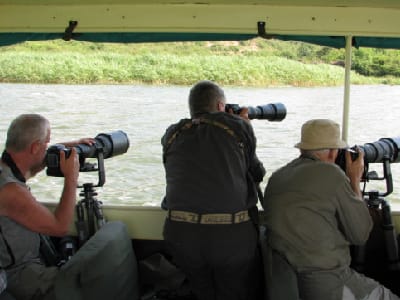
After a proper lunch by the banks of the mighty river Nile, we take a three hours boat ride to the bottom of Murchison Falls, and enjoyable on the Victoria Nile we can find Giant Kingfisher, White-crested Turaco, and Rock Pratincole at the bottom.
Day 21: Whole day Boat Ride to the Delta and Evening Game Drive.
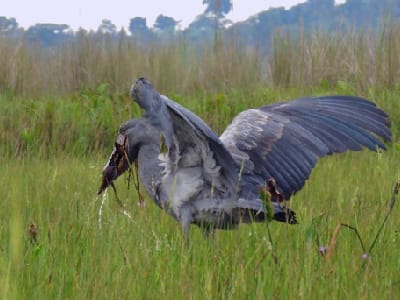
This morning, we take a morning boat ride to the delta; this sails downstream on the Victoria Nile into Lake Albert. It is an enjoyable nature ride, to and from. The birds love the riverine forest, as do the big mammals and reptiles to the bunks. It is here that one gets to lock eyes with the typical giant Nile Crocodiles that measure six meters and endless schools of Hippopotamus. The banks, riverine forest, and thickets are right for Giant Kingfisher, Grey-headed Kingfisher, Grey-headed Bush-shrike, the spectacular looking Saddle-billed Stork, Little Bittern, and the Shoebill. With a little more effort, somedays Pel’s Fishing-owl, White-backed and Black-crowned Night-Heron show up.We will do a lunch break and a siesta before heading out for the late afternoon to evening drive. This park has extensive savannah grasslands that give fantastic photography opportunities when the sun is setting. The Kobs and the other mammals with a background filled with the Albert Nile, Cattle Egrets flying back to their roost, and distant blue mountains with beautiful golden sunlight on them is a scene that hardly gets another to compare.
Good encounters with Giraffes should be expected. The evening drive that is on the plan, places us in what feels like the middle of nowhere. Imagine a spot where you are only surrounded by wildlife, a dark sky with only stars and the moon to pick out with no surrounding light pollution. It is living your favorite wild animal’s moment. This is also one of the favorite moments for some of our Avian Safaris guides. Depending on the season, we hope to find a few nightjars like Swamp, Slender-tailed, Long-tailed, Square-tailed, Standard-winged, Pennant-winged, Plain and European Nightjars, and Grayish Eagle-owl. New mammals to look out for should include, White-tailed and Marsh Mongoose, Bunyoro Grass Rabit, Leopard, Blotched Genet, Slender Gerbils, Fat Mice, and Spotted Hyena, among others.
DAY 22: Murchison Falls to Kaniyo Pabidi forest section
After early breakfast, we leave the park while birding heading to the Kaniyo Pabidi section of Budongo forest. We bird Kaniyo Pabidi for a few hours then proceed to the hotel in Masindi town. At Kaniyo Pabidi forest we should expect to see the Little green sunbird, the Grey-headed Sunbird, White-spotted Flufftail, Yellow-footed flycatcher, Sabine’s Spinetail, the exceptional Ituri Batis, the White-thighed hornbill, Blue-breasted Kingfishers, the Pygmy Crakes, the Green-breasted Pitta, Spotted Greenbul, Red-fronted Antpecker, Cassin Hawk-eagle, the Dwarf Kingfishers, the Yellow-crested woodpecker, Brown Twinspot, Chocolate-backed Kingfisher, the Cassin’s Spinetail, Crowned Eagle, the Cameroon Sombre, Lemon-bellied Crombec, the Puvel’s Illadopsis (only found within this Forest and no other place in the whole of East Africa) in addition to the Piping hornbill among others.
DAY 23: Transfer to Lake Bisina.
On this day, we bird to Lake Bisina the home to Uganda’s endemic species, the Fox’s Weaver. The dense thorn and savannah vegetation near the T-junction along Mbale road 11 kilometers from Town is known habitat to exceptional bird species such as the handsome silver bird, Jackson’s Hornbill, Brubru and Eastern Violet-backed Sunbird, Fawn-colored Lark, White-bellied Go-away Bird, African Grey Flycatcher, Pygmy Batis, Yellow-bellied Eremomela, Mouse-colored Penduline Tit, and many others. When you continue south from the junction for approximately 5 kilometers, you will find the Dark Chanting Goshawk, beautiful Black-headed plovers, Yellow-necked Spurfowl, and the Crested Bustard while the Temminck’s Courser, D’Arnaud’s Barbets, and the Grey Wren Warbler are commonly spotted at the airstrip near Town.
DAY 24-25: Whole day birding around Lake Bisina
The Lake Wetland System is an Important Bird Area a shallow freshwater lake with a thin strip of fringing papyrus swamp, part of the Lake Kyoga Basin lakes. Water lilies, a declining habitat in much of Uganda, dominate the shallow areas, which is important for its diversity of macrophytes. It is used as a feeding ground by wading birds, including the globally vulnerable Shoebill (Balaeniceps rex).We bird for two days in this area as we search for the Fox’s Weaver (Uganda’s endemic bird). The area has water habitats harboring the Shoebill and several other bird species, both water, and woodland. We spot in the swampy area of the lake Lesser jacana as well as the African Pygmy Goose and wading birds. Additionally, the elusive shoebills are frequently spotted at the edge of the vast papyrus vegetation.
DAY 26: Transfer to Mt. Elgon National Park
The park harbors 43 of the 144 species of the Guinea-Congo Forests biome and 56 of the 88 species of Afro-tropical Highland biome that occur in Uganda. There are isolated records of the near-threatened species, the Taita Falcon.
DAY 27: Whole day birding in Mountain Elgon.
Whole day birding, search for Hunter’s Cisticola and Jackson Francolin, Moorland Francolin, Moustached Green Tinkerbird, Alpine Chat, White-starred Robin, Cape Robin-Chat, Blue-shouldered Robin-Chat, Little Rock-Thrush, Northern Anteater Chat, Nightingale, Spotted Morning-Thrush, Mountain Yellow Warbler, African Reed Warbler, Little Rush Warbler, Upcher’s Warbler, Blackcap, Common Whitethroat, Common Chiffchaff, the Uganda and Brown Woodland Warblers, Green Hylia, White-browed Crombec, Yellow-bellied Hyliota, Stout, Thrilling, and Rattling Cisticolas, chances of seeing the Banded Prinia, Chestnut-throated Apalis, Northern Double-collared Sunbird, Grey-headed Sunbird, Yellow-billed Shrike, Ludher’s Bush-shrike, Cape Rock, Fan-tailed and White-naped Raven, Chestnut Sparrow, Chestnut-crowned Sparrow-Weaver, White-headed Buffalo-Weaver and many more.
DAY 28: Transfer to Mabira forest reserve
We bird to the biggest forest reserve closest to the city center with a record of 315 bird species. The forest has 74 of the 144 species of Guinea-Congo Forests biome that occur in Uganda.
DAY 29: Whole Day Mabira Forest
Whole day birding, Search for the Nahan’s Francolin which is an IUCN Red List of endangered species, Cassin’s Hawk-eagle, White-spotted Flufftail, Afep Pigeon, Grey Parrot, Dusky Long-tailed Cuckoo, Black-shouldered Nightjar, Sabine’s Spinetail, Cassin’s Spinetail, Blue-throated Roller, African Dwarf Kingfisher, White-bellied Kingfisher, Forest Woodhoopoe, African Pied Hornbill, Black-and-white Casqued Hornbill, Speckled Tinkerbird, Yellow-throated Tinkerbird, Yellow-spotted Barbet, Hairy-breasted Barbet, Yellow-billed Barbet, Green-breasted Pitta, African Shrike-flycatcher, Jameson’s and Chestnut Wattle-eyes, Forest Robin, Fire-crested Alethe, Red-capped Robin-Chat, the Speckle-breasted, Yellow-crested, Brown-eared, and the Buff-spotted Woodpeckers, Cassin’s Honeyguide, Red-tailed Bristlebill, name it.
Day 30: Transfer to Entebbe for your homebound flight.
While we return to Entebbe for departure, the drive has the potential of adding good birds to our list, I will list a few of them; Brown-backed Woodpecker, Black and Red-shouldered Cuckoo-shrike, White Helmet-shrike, Yellow-billed Shrike, Red-winged and Orange-winged Pytilia, Bat-hawk, Beaudouin’s, Short-toed and Brown Snake-Eagles, Abdim’s Stork, Thick-billed Cuckoo, Green-backed Eremomela, Bar-breasted Firefinch, White-shouldered Black-Tit, White-browed Sparrow-weaver, Singing Cisticola several other residents and migrants depending in the season.
Transport
We will use Toyota Land cruisers for this tour. Each vehicle has sufficient window seats for the whole group to have one, although we would ask that you rotate around the vehicle to give everyone the opportunity to have a seat towards the front of the vehicle. A good amount of our time will be spent away from the vehicles on bird walks.There is a good amount of luggage space in the vehicles, however, it is preferable if you can bring soft-sided luggage as this is easier to pack in, and keep your packing to a sensible, practical minimum.
At Mabamba Swamp and Queen Elizabeth National Park, we will also use boats or canoes to view birds from the water. Life jackets are available and it is recommended that these are worn throughout the boat trips.
Weather
A typically equatorial climate ensures that the weather will be varied, and you are likely to encounter some rain on tour. Showers should not last too long and will not hamper the birdwatching. Days will generally be warm or hot and sunny; however, overcast conditions are frequent, particularly in the forest and mountain areas. Nights will be mild to warm, cooler at higher altitudes.
Group Size
This tour can be accompanied by an International tour leader together with a local field ornithologist, and a driver. The minimum group size is 1 pax and the maximum group size will be 14 pax. Group size determines the number of field guides leading a tour. For example, if the group size is 14 pax we 2 field guides with 2 vehicles participate in the trip. If a big group opts to travel in one vehicle, we use a mini coaster. All the two transport options are perfect for your tour.Food & accommodation included in the package
All accommodation and meals are included in the cost of this holiday trip, drinking water will be available in the tour vehicles during the day throughout the trip. Please bring a water bottle, so that you can refill it from the larger containers.We use a combination of comfortable lodges, tented camps, and guesthouses on this tour. Whilst standards are improving in Uganda, some of the accommodations can be quite simple in nature. All rooms are clean, however, with private facilities and should be perfectly adequate for the group's needs. If you experience any problem with your room, please let your local guide know and they will always endeavor to rectify the problem with the lodge. A number of lodges operate generators for electricity, which are only run during the day so keeping a torch by your bedside is useful in case you need to get up at the night.